Showing posts with label Derrida. Show all posts

Friday, 17 June 2011

Black Christmas and the Dread of Difference


In a previous post on this blog, Looking through Gary Gilmore's Eyes, I discussed the fairly widespread use of what has been called the I-camera; that is, when a scene is being filmed as if through the eyes of one character, to let the audience see just what that specific character is seeing. In horror films, it is inevitably the villain's eyes through which we are invited to look. I argued against the idea of I-camera as forced identification and linked it rather with the Derridean idea of horror in seeing yourself seen.

Upon watching Black Christmas (1974) for the first time quite recently, it struck me how much more meaning there lies in the act of watching, and the knowledge that you are being watched, in horror films.
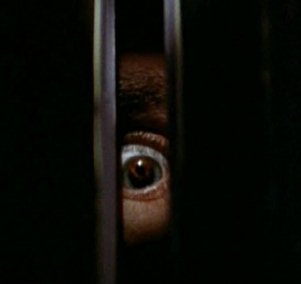


The use of I-camera or "forced identification" probably goes further than just pointing out how essentially different the "evil" character is to normal people. The fact that it is always someone watching from the outside as seemingly normal people engage in completely normal, everyday activities – before this character ends up killing them all, or at least trying to – is a way of demonising difference. Once the quality of "difference" is marked as truly monstrous, it is not a terribly long way away to judge those who are different as equally horrible.

In the excellent collection of essays on horror films and gender, The Dread of Difference, editor Barry Keith Grant writes in his introduction:

In 1986 Constance Penley wrote that "science fiction film as a genre –– along with its evil twin, the horror film –– is now more hyperbolically concerned than ever with the question of difference". Certainly she is correct in her observation about the genre's concerns, although her use of the temporal qualifier ("now") is perhaps somewhat misleading, for such treatment has tended to characterize the genre throughout its history.

I think that this goes further than just being limited to gender issues, although that is what Grant (and normally myself) is preoccupied with. If that's where it stopped, Black Christmas would simply be about a group of sorority girls who are afraid of one man. While it would be useless to claim that that outline is not part of what is happening (plot: a group of sorority girls are being stalked and slashed, one by one, by an unknown man), it is a lot more interesting to think in broader terms with this one. It is the fact that someone is watching from the outside that is the source of the horror in this film, as in countless others. Someone who is not like "us" (that is, the sorority girls or whatever group of mostly average people we are meant to sympathise with in any given slasher film), and who can only ever hope to watch from the outside as we carry on with our normal, somewhat dull, activities.

I struggle to think of any kind of successful film plot in which some kind of irreconcilable difference does not play an essential part; and it's no wonder, because what conflicts would there be without difference? And could an interesting story ever be told without some kind of conflict in the core? Possibly not. That does not mean, however, that the kind of demonising of difference which takes place in so many horror films is unproblematic.

Sunday, 26 September 2010

Looking Through Gary Gilmore's Eyes

I might as well introduce you properly to Carol Clover before we go any further. Her essay "Her Body, Himself" (originally published in her book Men, Women and Chainsaws [1992], and later in the excellent compilation edited by Barry Keith Grant: The Dread of Difference [1996]) is what got me into horror film theory in the first place and it is one of the most groundbreaking essays in the field. It is also one of the very first critical essays to pay any kind of (serious) attention to slasher films. Obviously some of it will be a bit dated by now, but it remains the origin of some of the most essential terms and ideas – especially for those of us interested in the slightly icky gender issues side of horror films and their theories. Perhaps most importantly, Clover coined the term Final Girl – used to describe the girl who is typically left alive at the end of a slasher film. However, there is another issue which she spends just as much time discussing in the essay, namely that of audience identification in horror films. She makes lots of claims and arguments relating to that which I'm not going to go into detail about here (for now, anyhow), but what I will focus my attention on is her critique of the widespread use of I-camera in these films (pretty self explanatory: bits of the film are being shown as if you are watching through one character's own eyes):

"Much is made of the use of the I-camera to represent the killer's point of view […] By such means we are forced, the argument goes, to identify with the killer", Clover says, and then of course she goes on to make some big and very long-winded points about the nature of "the processes of viewer identification", and she only entertains this idea of forced identification through I-camera for so long, but she never really returns to this point to disprove (or even prove) it.


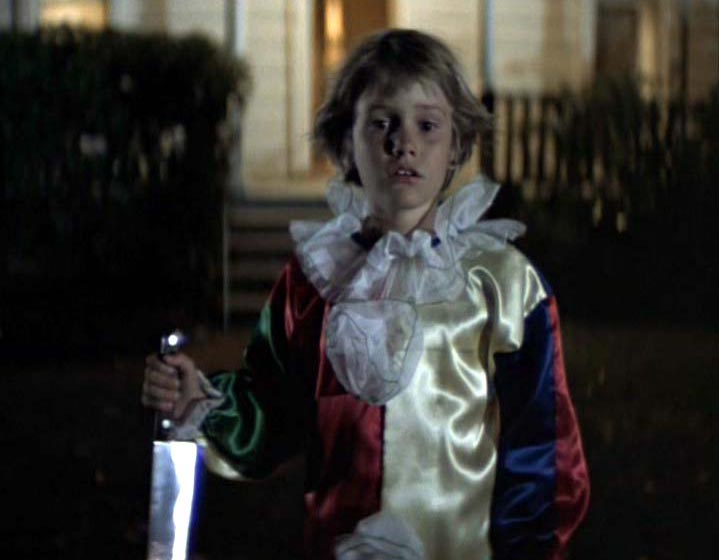
For me, there are two scenes from two films that first spring to mind when I-camera usage is being discussed. The opening scene to Halloween (1978) in which the young Michael Myers lurks around the house and eventually kills his sister; and very near the beginning of Friday the 13th (1980) where the killer walks through the camp, watching the careless youths as they sleep in their beds or whatever it is they are doing. (Of course, in this film you get a lot more I-camera being used because you're not supposed to know who the killer is...) The thing that strikes me about both of those instances, and any other that I can think of, is how all you see through the killer's eyes (as it were) are apparently normal people engaging in completely normal activities – whether that's having sex, sleeping, brushing their hair, taking a shower, whatever. So I'd argue that you're not really forced to identify with the killer at all even though you're seeing things from their perspective – because there is nothing in the scene that would make you (assuming you're a normal, well balanced person) think to yourself, "what an arsehole, I would definitely kill them". If anything, it only serves to make you more distanced from the killer, as there is no logical or recognisable reason presented to you for why you should want to kill the people you are watching. So this specific use of I-camera only really illustrates how completely alien the killer is.


Another thing that interests me with this is how well it works with everyone's favourite deconstructionist Jacques Derrida's musings on the feeling of horror upon seeing yourself seen (yes, I did just go there). JD initially talks about the feeling of bewilderment and unease when he caught his cat staring at him (he was also NAKED at the time, dear me). His theory is something about how thoroughly and deeply unsettling it is for a person to realise that they are being watched – ie. seeing themselves seen – by some Other being. Preferably not another human being, that wouldn't be as creepy, and that happens quite a lot as well. This was first explained to me in the context of The Birds (1963), and it is argued that a large portion of the feeling of unease and even horror in the film comes from the fact that we witness the birds actively watching people.

And I think that this can, and should, be applied to the discussion of I-camera and (forced?) identification in more conventional slasher films. Yes, the killers are human in form, but one of their absolutely essential trademarks is that they are not ever entirely human. Mike Myers, for example, is described as "pure evil", with no human attributes left at all; Leatherface is another obvious example: he uses different masks to determine his "personality" and the way in which he behaves at any given time. Clover even backs me up on this one, claiming that the killer "may be recognizably human, but only marginally so".  Any more details about that specific aspect of it all will have to wait until some other time, though. I'm going get out of here while I've still got both Derrida and Clover behind me – but first, a summary:

So – even though it would be handy for a lot of feminist critique if it really were a case of "forced identification" where you identify with the killer and against his victim(s), that doesn't seem to me to be the case. The effect of the I-camera is a scary one, because you don't know who it is that's watching and you certainly see no reason why you should be on their side. It plays upon the spooky feeling you get when you think (or know) that you're being watched – even as you're participating in normal, everyday activities that shouldn't really work as motivation for anyone to gut you like a fish.