Showing posts with label sex. Show all posts

Sunday, 29 July 2012

Whedon's Lesbians


Yes, it's cool that an American, more or less mainstream, tv show for teenagers featured a lesbian couple. But what does Joss Whedon's Buffy the Vampire Slayer really tell us about lesbians?

The main lesbian couple in the series is regular character Willow, and Tara who's on the show for a couple of seasons. By the time they meet, we have followed Willow since early high school, and seen her very long lasting crush on her best friend Xander, and after that her relationship with Oz. Both pretty "safe", traditional and straight relationships. Well, apart from Oz being a werewolf, but you know. In other words, we have come to know Willow as a normal young girl with normal drives. That is, until Oz breaks her straight little heart in pieces and she feels sure that she can never love again.

Enter Tara, the shy, weirdo outcast from the college (so called) Wicca group. She is quick to realise that she and Willow share their interest in actual magics (rather than just bake sales and scented candles like the rest of the group), and she first comes to Willow for help in some supernatural matter. We know straight away (no pun intended) that there is something a bit off about Tara. She even has a stutter, for crying out loud!

So social misfit Tara comforts heartbroken Willow, until they at one point realise that there might be something more than just straight girl friendship between them. The first time this is directly addressed, rather than just hinted at through shy looks passed between the girls, is when Oz briefly returns and shouts at Tara, IS SHE IN LOVE WITH YOU!? The ordeal of processing this is enough to turn the newly "fixed" or "healed" werewolf back into a furry ball of rage. Tara assumes that Willow will go back to Oz rather than be with a freak like herself. But Willow comes back to Tara, and promises to make up for everything. Starting right now. They blow out the candle and they disappear in the darkness.
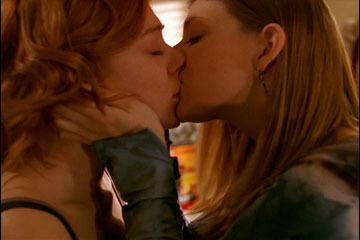


Maybe romantic, yes, but also symptomatic of something. It's like Whedon has to ease the viewers into the idea of an actual lesbian romance. I don't remember exactly the specific episode in which we first see Willow and Tara kiss, but it seems like an aweful long time after they become an item. Sure, the show as a whole is more innocent or easy on all the sexual stuff in the first couple of seasons while the Scooby gang are still in high school, but this is different. We've already seen Buffy get it on with at least two, if not three men; we've seen Willow and Xander get their smooch on which ends Xander's relationship with Cordelia; Willow has even been deflowered by Oz. And isn't it around the same time that Buffy and Rilley nearly get a lot of people killed by a possessed house, on account of all the hot and steamy sex they're constantly having? Yet it takes ages before we see just the smallest, most innocent kiss from Willow and Tara. Firmly established as a couple by then, most of their early kisses are securely grounded in the safety of casual, everyday moments. As if it were the most natural thing in the world, perhaps – or perhaps because it isn't safe to make an equally big deal out of the romance and lust of a pair of lesbians as what is done with their straight friends.

I guess that what bugs me most about the whole setup, though, is the fundamental connection with magic. As I have mentioned above, magic is what brings the two girls together. Which is fair enough, it's not as if they're the only ones on the show to have interests or hobbies of the somewhat supernatural kind. But just as straight sexuality is more than once in the series recognised by brutal, animal behaviour (vampires, werewolves, etc), lesbian romance and sexuality seems something that can only really exist in inscence-smelling, candle-lit rooms by girls clad in earthy tones, who communicate with godesses and do cute magic tricks with sparkly powders and so on. The magic, the fact that Tara and Willow have the power to communicate with powers outside of themselves which can allow them to bend the laws of nature at their will, makes sure that their lesbian relationship is thoroughly, unforgettably marked as unnatural. It's something for witches, not for normal people.
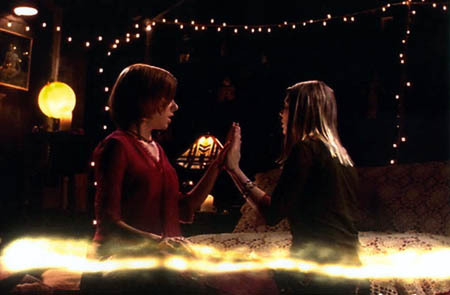
Theirs was a magic kind of love.


Of course, this changes in the final season after Tara is out of the picture and another girl takes interest in Willow. But that girl is so clearly only interested in sex, and in being socially controlling, that I'm not sure how much better that works out.

Anyway.

The magic does get too much for Tara as well, eventually. Willow starts using magic for every little thing that she could have just as easily taken care of otherwise – like searching through books or on the computer for information, or pulling the curtains shut. When Willow clearly can't go even a week without using magic, Tara leaves her. I'm unsure if this fits into the whole symbolic thing. One way of looking at it could be, if we think of magic as one of the biggest markers of their lesbianism, that Tara wishes Willow wouldn't flaunt it so much. She might feel that it's more of a private thing, and resents Willow for making it extremely public, without taking her girlfriend's feelings into consideration. Which would basically tell us that public lesbianism is bad, mmkay?

After some time apart, Willow manages to get her powers under control again, and the couple find their way back to each other. Their relationship is more explicit onscreen now, but mainly within the confines of their own bedroom.

Then, the tragedy. Tara dies, from a gunshot that was meant for Buffy. Whatever kind of control Willow had got back, that and much more is instantly lost. She becomes an evil Super Witch and tries to end the world. She did for a moment turn to magic when things ended with her and Oz as well, but never anything like this. After all, she was a straight little girl back then, and her Magic Lesbian Superpowers weren't fully developed. But now we see what a long-term lesbian relationship has done to Willow, once the tiny geeky cutiepie. A lot happens, but the highlights include her fighting, both physically and psychologically, all of her best friends; she kills a man (Tara's killer) in a pretty gruesome way; and she does try to end the entire world, before good old Xander, her first crush and life-long best friend, comes along and sweet talks her out of it. Basically. But narrated in a more dramatic way than that, as I'm sure you can imagine.
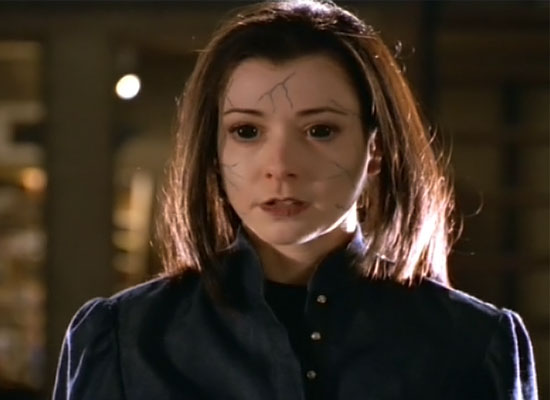
You don't wanna mess with this heartbroken lesbian.


When Kennedy, the other girl that I mentioned above, who takes an interest in Willow, first gets her to play along with her flirting, Bad Willow seems to reappear. She suddenly inhabits the body of Warren, Tara's killer, and gradually turns into him mentally as well. (S)he goes right out and buys a gun and plans to kill the evil lesbian that made her do the smoochies with her. Which was the exact moment that Willow physically turned into a man, by the way – when they first kissed. But no one is killed this time around (although Willow blames herself for "killing" Tara by letting her go), as Kennedy manages to remind Willow that she is her, a woman, not a crazy blood-thirsty man. Several make-out sessions ensue, in front of people and everything, so at least that's a good thing.

It's not as if Whedon's lesbians are made out to be horrible people, and I don't think that Whedon especially dislikes lesbians. But maybe this can serve as an example of how easy it is to misrepresent something with pretty comically bad consequences. In this case though, no one, no matter what sexual orientation or gender, gets off pretty easy. Too many demons in Sunnydale for that.

Saturday, 7 May 2011

From revenge to rape, and back again. Part 1

This post has been a long time coming. And not only because it's a long time since I've posted anything. I've been trying to make sense of the rape-revenge sub-genre ever since I was introduced to it (once again, credit goes to Carol Clover). Maybe not even so much the genre or the movies themselves but something to say about them. Can anything sensible be said, that isn't already said elsewhere?

For those not familiar with the phenomenon: a rape-revenge film is exactly what it sounds like. A person (typically a woman... I'm not aware of any examples where a man is the victim. If you know of any, please comment below) is raped brutally, seemingly unprovoked. She is then left for dead or at least assumed unwilling or unable to do anything about the situation. Her hatred builds up and drives her to perform hideous acts of revenge. Sometimes, the person executing the revenge is not the victim herself but rather someone close to her (especially, of course, in the cases where the victim is actually killed), such as a boyfriend or parents. The rapist(s) is often killed. There are variations, as you will soon enough see, but that is the standard outline.


Not strictly speaking the first of its kind, I Spit On Your Grave (1978) has certainly come to be the defining movie of this bizarre sub-genre.


There was a remake of this film released last year. In 2009, there was a Norwegian rape-revenge film called Hora ('The Whore'), which made all sorts of claims about being the first Norwegian grindhouse film and other things besides, and as far as I am aware it never said anything about being a remake. It was, though. This made me think, again, about what this genre actually is. Can it even be said to be an actual genre, a type of film, or is it just basically one film and endless remakes and variations?

In this post I will try to provide you with a kind of history of the evolution of the rape-revenge film. In some cases, it will be debatable whether the films I'm talking about are actually rape-revenge films at all. Debate away! I've mainly just picked films that help to illustrate my point. Which is hinted at in the title of this post.

Ready? Let's go!

For many reasons, the brutal visual representations of rape have not been around for many decades. Censorship rules and standards of what might be socially acceptable have, as you might be aware, not always been the same as they are today. Movies have always included stories more or less about sex though, and women scorn, and bitter, hateful vengeance. Look, if you will, to the 1958 classic Attack of the 50ft Woman:

When an abused wife grows to giant size because of an alien encounter and an aborted murder attempt, she goes after cheating husband with revenge on her mind.
Here, the theme of female revenge over a male object is brought into horror, and even sci-fi, terrain. Granted there is no hint at an actual rape, I'm sure you could interpret a rape into it if you really wanted: maybe the alien raped Mrs. Archer? Maybe it was a forced marriage that could on some level be likened to rape? Maybe it was just what is popularly referred to as "emotional rape"? Who knows. The revenge motif is clear, and we're talking a real physical type of revenge.


By 1972, things were naturally different. For a start, Wes Craven was in business. And in The Last House on the Left, he is introducing one of his favourite themes: teenagers rebelling against their parents. With added rapists.

Two girls get raped in this film, and the representation of the two rapes are quite different. The first rape is that of the tougher girl, Phyllis, and is not very graphic at all. You hear some noises and Phyllis telling them to 'stop it', but overall it almost seems as if it was a far worse experience for her when she was forced to 'piss her pants'. The rape of her more innocent friend Mari is far more exhausting on the viewer, and the experience of being raped is here pretty much likened to death. Mari is being stabbed in the chest almost while she is being raped (but I think the stabbing takes place just after the other kind of penetration), blood spurts out, she screams and cries and begs for her life. After being raped, Mari gets up, covers herself up and walks into a lake. She is then shot. It seems almost that death is the only possible consequence of being raped.

It is Mari's parents who punish the brutal gang for their crimes after they realise she has been killed. Maybe this is another "mother and father know best" kind of thing? Coming from Craven though, that would be a bit strange (see: A Nightmare on Elm Street (1984), The Hills Have Eyes (1977), The People Under the Stairs (1991), the Scream films, etc.). Interestingly (though a bit of an aside), one of the men repsonsible for Mari and Phyllis' rapes and deaths, dreams of Mari's parents taking out his teeth. Apparently this can represent 'a fear of rejection [or] sexual impotence', or a loss of 'childhood innocence'.


Although Jennifer in ISOYG is the victim of that film as well as the avenger, she certainly has common traits with Mari's mother. As opposed to Mari, they are both fully adult women, who do not hesitate to use sex as a way of getting back at the ones who have somehow hurt them. In both films, the men do not seem to have any doubts about the legitimacy of the women's approaches – maybe believing themselves to be that irresistable, or in Jennifer's case that they have somehow changed her mind about them; that deep down, she must have enjoyed the rape(s).

I realise I have not really paid much attention to the rape scenes themselves. If you have not seen these films you will just have to take my word for it: they are there, and they are quite graphic. Indeed, 'the length of the rape sequence, the prolonged physical and mental anguish suffered by the victim' were among the reasons why ISOYG was originally refused classification. (Here is a link to the Video Nasties documentary.)

In order to prevent this post from getting so long that no one will want to read the whole thing, I will pause here and get back to you with a part 2 within a couple of days. There will be quite a leap in time in terms of films being discussed as well, so this is a good place to take a break.

Oh, and while we're all here: it is now possible to be become a fan of Tits And a Scream on Facebook! I set it up so that I can share funny links and film clips and stuff, and still keep this blog as "clean" as possible. See you there, guys n gals.

Wednesday, 24 November 2010

Antichrist and the Nature of Horror

"the feminine is not a monstrous sign per se; rather, it is constructed as such within a patriarchal discourse"
Barbara Creed

As you will no doubt be aware, Lars von Trier's 2009 flirt with horror, Antichrist, found itself at the centre of quite a lot of controversy upon its release. At the core of the debates surrounding the film has been the question of misogyny: is the film as misogynistic as many critics seemed to believe, or is it "actually" just one big feminist statement? The minds of the public will probably never be made up about this, and both sides seem to have little trouble arguing a strong case with proof  taken exclusively from the movie itself. While I am normally all for a gender centric analysis of horror films, it seems to me that maybe this is missing the point a bit in the case of Antichrist: when it is so obviously quite possible to to make such strong arguments on both sides, couldn't this be a sign that the whole excercise might be just a bit pointless? By all means, I'm a big fan of using movies to make a point of some sort; but this is a film that can basically "mean" anything that you might want it to. However, there's no real getting around the fact that there is a lot of talk about fear in the film. The main topic of discussion is what makes the nameless female played by Charlotte Gainsbourg, afraid – or what makes people, in general, afraid. Nature is being named as one source of horror and to me, it deals quite explicitly with the very nature of horror.


 The link between nature and horror is hardly something new. Linking sex and nature with horror likewise. One scene that popped to mind whilst watching Antichrist was from The Evil Dead (1981). You know the one, when the girl walks off into the forest at night and the forest itself literally rapes her. I won't pay any particular attention to potential rape motifs in Antichrist in this post (although I will return briefly to the Freudian aspects of it a bit later on), mainly because there are just too many and it would take up too much space in a post that is about something different. But I thought that specific scene was worth mentioning anyway. For example in relation to Charlotte Gainsbourg masturbating furiously in the forest, then being joined by her husband who gives her a good slapping.

With this film, Lars von Trier seems to bring the sex back into the world of horror. Because in recent years, it has become less and less essential to the horror genre, as far as I can tell. It is now mostly about the torture, as discussed in my previous post, and the focus has been removed almost entirely from the sex which was always a major source of horror in the past. Look at Psycho: you don't witness any sex acts actually taking place on screen, yet still the entire film is absolutely chock-full of it. Marion and Sam get dressed in the hotel room; you see Marion in her underwear several times and obviously naked in the shower; Norman was aroused by Marion (according to the psychiatrist in the final scene), etc etc etc. Now, even something like Hard Candy (2005), which is in its own way all about sex, doesn't show any actual sex take place. In Antichrist though, there is LOTS of it, and it is very detailed. As anyone with even the vaguest interest in traditional horror films will know: bad things happen to people who have sex. Especially sex of the more irresponsible kind, and what could be more irresponsible than to let your child fall to his death while you are busy lovemaking?


When I was watching the film for the first time a couple of weeks ago, it took me a good half hour or more to try and figure out what on earth I was even watching (and I've been led to believe that a lot of people never do figure that one out). I had heard and read so much about how Antichrist was a horror film. For a while, I didn't see much to back up this statement. Sure, lots of psychological stuff, some of it quite creepy. But enough to make it a horror film?

After a while, though, I realised just how much of a horror film this is. Maybe even more so than most of the ones we like to call classics, or essential, or just traditional scary movies. Because here is a film that is about fear and about horror, rather than just trying to scare its audience with a man in a mask and making us jump when he appears out of nowhere and kills some people. (A film's "quality as horror film", says Carol Clover, "lies in the ways it delivers the cliché".) For me, some of the conversations that the nameless couple lead are sufficient "proof" of this. And I will now go on to provide you with some valuable quotes from said conversations:

Before leaving for Eden, He tries to find out what She is really afraid of:
H: Let's make a list of things that you are afraid of.
S: But I don't know what I'm afraid of … Can't I just be afraid without a definite object?

Later, one evening at Eden, they do a little "therapeutic" excercise, in the form of a role play (this is after He has placed "nature" at the top of She's "fear pyramid"):
H: My role is all the things that provoke your fear. Yours is rational thinking. … I'm nature. All the things that you call nature.
S: What do you want?
H: To hurt you as much as I can.
S: How?
H: How do you think?
S: By frightening me?
H: By killing you.
S: Nature can't harm me. You're just all the greenery outside.
H: No... I'm more than that.
S: I don't understand.
H: I'm outside, but also... within. I'm the nature of all human beings.
S: Oh, that kind of nature. The kind of nature that causes people to do evil things against women?
H: That's exactly who I am.

And finally, about She's research for her thesis on gynocide:
S: If human nature is evil, then that goes as well for the nature of...
H: ...of the women?
S: The nature of all the sisters. Women do not control their own bodies. Nature does. I have it in writing in my books.
H: The literature that you used in your research was about evil committed against women, but you read it as proof of the evil of women?

It is difficult to even know where to begin with this. I have watched these scenes twice now and each time a hundred different thoughts have popped into my head, but I will try to make it as short and as relevant as possible. It is made clear from these excerpts that we are in fact dealing with the kind of irrational fear that most horror films do indeed play upon. Ie., we know fully well that Freddy isn't going to slice us open as we sleep, but we still fear it. Notice how it is made very clear that there is a mutually exclusive opposition between rationality and fear. I think it's also really interesting that they bring up the idea of being afraid, but not because of something specific. Most horror films will have a specific object of fear; however, they will inevitably depend upon the ability of the viewer to be genuinely afraid of something that is not in fact dangerous to them in any real way. Furthermore, there is, of course, talk of women. I'm not, after all, trying to deny that there are gender issues being somehow or other adressed, or at least pointed out, in this film. What I do think about it though, is that rather than von Trier trying to make some statement about these things, be it a misogynistic or a feminist one, he is simply pointing out that this is a major issue in horror tradition. The nature of women, and the nature of men (or, as She aptly puts it, "people". Who are "people", historically speaking?).


There is at least one other blogger who somewhat agrees with me on this, saying that "Ultimately, I think he's making a horror film that suggests misogyny is at the core of all horror films and religious parables. Actually, to go even further, I think his attack is on the misogynist underpinnings of western rationalism as such."

And let's not at any point forget that there is one person here to represent rationality and science, and another to represent wildness, raw nature, and even evil. That the former is male and the latter is female is not, I believe, because von Trier believes that this is a true and accurate representation of the genders as such: rather, he is only pointing out what traditional horror has been doing for decades, if not centuries.

Another thing that has been very present in many a modern horror film, and especially in the many theories and criticisms surrounding them, is of course Freudian theory. Barbara Creed's essay Horror and the Monstrous-Feminine is the place to start if you are interested in looking into this. In the essay, Creed quotes Freud as saying that the Uncanny is "something which ought to have remained hidden but has come to light". There seem to be many things in Antichrist to which this description can easily be applied. Most of all, though, it seems to me to be certain elements of human nature that ought to have remained hidden, if you follow the logic of the film. Not only the evil female nature, which admittedly gets paid the most attention: even the big protector of rationality in the film ends up performing what can only be described as unhumane acts. For once though, I don't want to give away the ending. Anyway, Freud and that: again, so many things to choose from, and I'll settle for mentioning some of the most obvious things. There is a mother – father – son motif turned more or less on its head; there is the fox hole and the "thick" trunk right next to it; He tries to hide in the fox hole when She is chasing him, only to be buried alive in it. This happens after She has practically castrated him, and before she "practically" castrates herself (who says women can't be castrated?). Earlier in the film, after her psychiatrist husband has told her about having some odd dreams, She tells him that dreams don't matter to modern psychology: "Freud's dead, isn't he?"


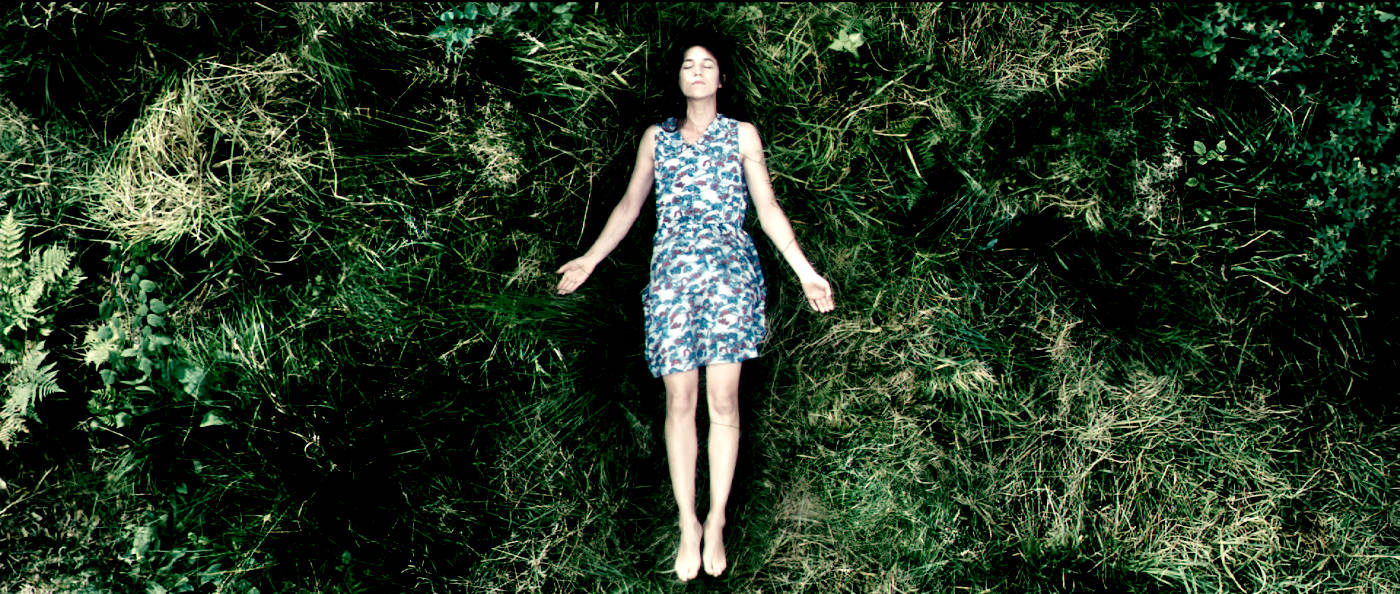
 I want to return to He's attempts to rationalise She's fear. He tells her in the early stages of the film that "grief is natural". He tries to make her realise that the things that she fears are not actually dangerous, and he does this at first by seemingly hypnotising her and making her go into Eden, lying down on the grass and "melting into the green". By doing this, he is almost forcing her to become part of the thing that she fears the most: nature. She is convinced that nature is evil, and when she is forced to be part of nature, she becomes "evil". She clearly believes in the ability of his words to become reality; this is illustrated through one of their discussions about her thesis, when She accuses him of finding her subject "glib". She admits to never having finished her thesis, saying that "all of a sudden, it was glib". If this is the logic we are to follow, it might well be that He makes his biggest fatal mistake (other than claiming, in the role play mentioned above, to be all of the things that she is afraid of...) when he tells her that "your thoughts distort reality. Not the other way around". Her thoughts, her way of seeing the world, do indeed distort and change reality for both of them.

He believes that She is suffering from anxiety, and tries to persuade her that "anxiety can't make you do something that's against your nature". In response, she certainly does her best to convince him of the true nature of, well, nature. And finally, in yet another attempt to rationalise, He tries to explain to her that "obsessions never materialise. It's a scientific fact". Ironic, then, that her obsession with gynocide influences him to put an end to it all in the specific way that he does.

(I have a feeling that I might return to this one.)