Showing posts with label witches. Show all posts

Friday, 19 October 2012

Dunderland (2012) – Witch hunt meets female Jack Torrance


Dunderland is the first Norwegian horror movie to take on the witch hunts which in this country took place mainly in the 16th and 17th centuries. I was pretty excited about this, thinking it's about time that this shit hit the big screens. This film doesn't really engage with the witch hunt stories much though, other than as a backdrop. As a deep, male voice informs us in the intro; in the year 1695, 16 year old local girl Johanne Nilsdotter was accused of witchery and thrown in the lake. Her body was never found, but the community in Dunderlandsdalen keep falling victim to strange, bizarre and tragic incidents. Eventually it gets so bad that the locals proclaim the village a cursed place, and abandons it.

Fast forward to the 21st century, and stage director Laura brings her troup of actors to Dunderlandsdalen, meaning to create a stage play about the witch hunts – making reference to one of Norway's most well known "witches", Anne Pedersdotter. Needless to say, however, things do not go according to plan and weird shit starts happening. We soon understand that the house they've settled in is exactly where most of the bad things have happened over the years. A local farmer killed his wife and daughter with an axe before hanging himself in the barn; it was later used as a scout's camping place before one young girl went missing and the place is abandoned once again.
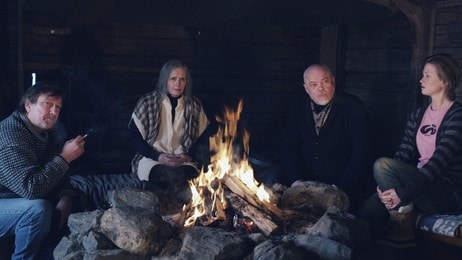
Creepy remote location? Check.
Obviously the theatre folks want to produce their play in the very same barn where the axe farmer went berserk, and before long, director Laura becomes even more eccentric than you would expect of someone in the theatre business. Then the crew start disappearing, and the mood amongst the remaining actors is less than good.

Meanwhile, the snobbiest of the crew (Paul) refuses to sleep in a cabin in the woods and leaves every evening on a snow scooter to go into town and a proper hotel. He wakes up in the middle of the night and finds a nazi party from WW2 in the living room. This all happens after he's talked to the creepy bartender who, as far as we know, is not a ghost. Paul also pays a visit to the town library where he finds heaps of articles about people who have gone missing in Dunderlandsdalen, bizarre accidents, and weirder than anything; an article in an older paper about the director Laura and her five actors gone missing.

All very creepy and thrilling, sure, but what does it mean, where does it take us? Where does the story go from here?

Turns out, Paul's entire business in the village is little more than a sidetrack for the story. He heads back to find the others and well, he won't get to make another trip into town for some time.
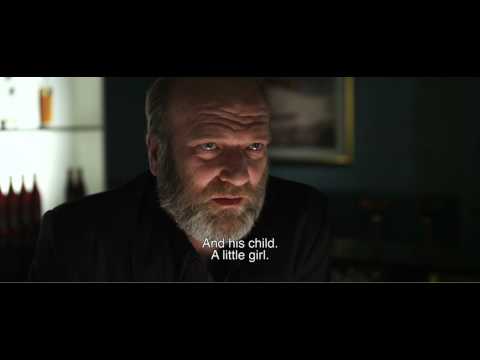
Creepy hotel bartender? Check.
Herein lies my issue with Dunderland; it can't quite decide on which of the many possible plots and twists and turns it presents, that it wants to stick with. There are enough ideas here for at least two or three seperate films, but when they're all thrown together in one 78 minutes long movie, it's simply too much. Or too little about whatever should have been the main story.

That said, I still like the film. The character Laura (Miriam Prestøy Lie) in particular. It's a welcome change to see that someone who isn't a middle aged man can play the weird eccentric lone wolf type person, and Prestøy Lie balances her character perfectly between misunderstood creative genius and a female Jack Torrance. The changes that her character go through in those 78 minutes is very impressive – and my initial fears that she might be a bit of a boring characters are put duly to rest.

And although the film doesn't use the material of the witch hunts as much as it could, at least it does bring it to the big screen. In my view, this has proven again and again to be one of the (many!) strengths of genre film; bring unpopular or controversial stories and motifs to the big screen, so it gets just enough attention for others to want to follow.

A "witch" meets her fate
I do hope, however, that the next time we see Norwegian "witches" (can't use that word without quote marks in this setting, really) in a movie, they will make her less witchy looking. The girl we are presented with in the opening sequence looks like she's lived her whole life in the woods, dirty and in tattered clothes and with hair that's never had a date with a bar of soap or a hairbrush. This is not what most women accused of being witches looked like. On the contrary, they were quite normal women who might have got in a quarrel with the neigbours or become the focus of someone's disliking in some other, normally quite innocent, way. Or, like Anne Pedersdotter as mentioned above; she became a widow not too long after she was first accused of witchery. By both inheriting her husband's wealth, living in isolation and growing more and more aggressive towards her fellow townspeople who, in her defence, were all convinced she was banging Satan or something of the sort. This combination of characteristic qualities didn't do much for her case however, and in 1590, fifteen years after she was first accused, she went on trial and ended up being burned alive at the stake.

It's not that there might never have been anything weird about any of the women accused of witchery, in fact I'm sure most of them were a right bunch of weirdos, much like their accusators and pretty much anyone else, ever. But playing up to that idea of these women as wild creatures, somehow more connected with nature than the rest of us, and with a truly mystical personality – it doesn't do any favours for anybody. The very essence of the cruelty and atrocity of the witch hunts lies in that they were quite normal people. Anyone could be suspected and accused, it was often simply coincidence that decided who was the witch this week.

With all of this in mind, we can only imagine how difficult, near on impossible, it must be to make a movie even just touching upon this historical material, without coming across as slightly, well, misogynist. Because even though it was innocent people getting burned alive and drowned and whatnot, it was that idea that they had some unnatural (!) connection to forces of nature or the supernatural that became their doom. In Dunderland, the lurking evil resides in nature itself, which then takes posession of normal people. How can you present that story without making it look like certain people are being attacked or posessed for a reason? A reason that might live deep inside them? It's interesting at least to think about how this might make us share the perspective of the accusators of the "witches" for a moment; that moment when we might think "ahh, of course it was she who got posessed or who did that weird thing". Because the truth is that these accusations and suspicions were mostly as random as anything, and that's the most important thing to remember about these stories.

Should you want to read more about my thoughts on women with a supernatural connection to nature and why portrayals of this aren't always necessarily misogynist, I suggest you read this: Antichrist and the nature of horror.

Overall, Dunderland scores points for effort, but lacks some depth due to wanting to tell too many stories at once. I'd still recommend it though, it's pleasant viewing and an introduction to something we haven't seen to much about on the big screen, at least in recent times. And I for one will be very excited to see what lies down the road for both writers/directors, and star Miriam Prestøy Lie.


Sunday, 29 July 2012

Whedon's Lesbians


Yes, it's cool that an American, more or less mainstream, tv show for teenagers featured a lesbian couple. But what does Joss Whedon's Buffy the Vampire Slayer really tell us about lesbians?

The main lesbian couple in the series is regular character Willow, and Tara who's on the show for a couple of seasons. By the time they meet, we have followed Willow since early high school, and seen her very long lasting crush on her best friend Xander, and after that her relationship with Oz. Both pretty "safe", traditional and straight relationships. Well, apart from Oz being a werewolf, but you know. In other words, we have come to know Willow as a normal young girl with normal drives. That is, until Oz breaks her straight little heart in pieces and she feels sure that she can never love again.

Enter Tara, the shy, weirdo outcast from the college (so called) Wicca group. She is quick to realise that she and Willow share their interest in actual magics (rather than just bake sales and scented candles like the rest of the group), and she first comes to Willow for help in some supernatural matter. We know straight away (no pun intended) that there is something a bit off about Tara. She even has a stutter, for crying out loud!

So social misfit Tara comforts heartbroken Willow, until they at one point realise that there might be something more than just straight girl friendship between them. The first time this is directly addressed, rather than just hinted at through shy looks passed between the girls, is when Oz briefly returns and shouts at Tara, IS SHE IN LOVE WITH YOU!? The ordeal of processing this is enough to turn the newly "fixed" or "healed" werewolf back into a furry ball of rage. Tara assumes that Willow will go back to Oz rather than be with a freak like herself. But Willow comes back to Tara, and promises to make up for everything. Starting right now. They blow out the candle and they disappear in the darkness.


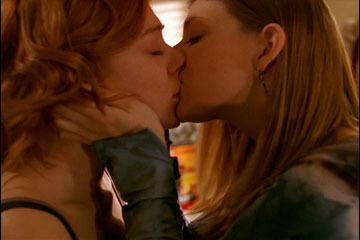
Maybe romantic, yes, but also symptomatic of something. It's like Whedon has to ease the viewers into the idea of an actual lesbian romance. I don't remember exactly the specific episode in which we first see Willow and Tara kiss, but it seems like an aweful long time after they become an item. Sure, the show as a whole is more innocent or easy on all the sexual stuff in the first couple of seasons while the Scooby gang are still in high school, but this is different. We've already seen Buffy get it on with at least two, if not three men; we've seen Willow and Xander get their smooch on which ends Xander's relationship with Cordelia; Willow has even been deflowered by Oz. And isn't it around the same time that Buffy and Rilley nearly get a lot of people killed by a possessed house, on account of all the hot and steamy sex they're constantly having? Yet it takes ages before we see just the smallest, most innocent kiss from Willow and Tara. Firmly established as a couple by then, most of their early kisses are securely grounded in the safety of casual, everyday moments. As if it were the most natural thing in the world, perhaps – or perhaps because it isn't safe to make an equally big deal out of the romance and lust of a pair of lesbians as what is done with their straight friends.

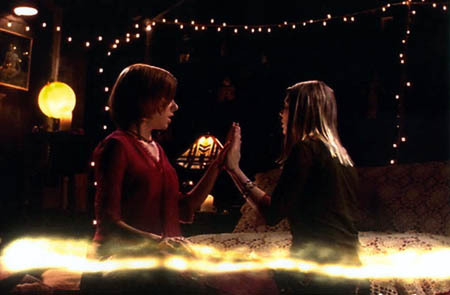
I guess that what bugs me most about the whole setup, though, is the fundamental connection with magic. As I have mentioned above, magic is what brings the two girls together. Which is fair enough, it's not as if they're the only ones on the show to have interests or hobbies of the somewhat supernatural kind. But just as straight sexuality is more than once in the series recognised by brutal, animal behaviour (vampires, werewolves, etc), lesbian romance and sexuality seems something that can only really exist in inscence-smelling, candle-lit rooms by girls clad in earthy tones, who communicate with godesses and do cute magic tricks with sparkly powders and so on. The magic, the fact that Tara and Willow have the power to communicate with powers outside of themselves which can allow them to bend the laws of nature at their will, makes sure that their lesbian relationship is thoroughly, unforgettably marked as unnatural. It's something for witches, not for normal people.

Theirs was a magic kind of love.


Of course, this changes in the final season after Tara is out of the picture and another girl takes interest in Willow. But that girl is so clearly only interested in sex, and in being socially controlling, that I'm not sure how much better that works out.

Anyway.

The magic does get too much for Tara as well, eventually. Willow starts using magic for every little thing that she could have just as easily taken care of otherwise – like searching through books or on the computer for information, or pulling the curtains shut. When Willow clearly can't go even a week without using magic, Tara leaves her. I'm unsure if this fits into the whole symbolic thing. One way of looking at it could be, if we think of magic as one of the biggest markers of their lesbianism, that Tara wishes Willow wouldn't flaunt it so much. She might feel that it's more of a private thing, and resents Willow for making it extremely public, without taking her girlfriend's feelings into consideration. Which would basically tell us that public lesbianism is bad, mmkay?

After some time apart, Willow manages to get her powers under control again, and the couple find their way back to each other. Their relationship is more explicit onscreen now, but mainly within the confines of their own bedroom.

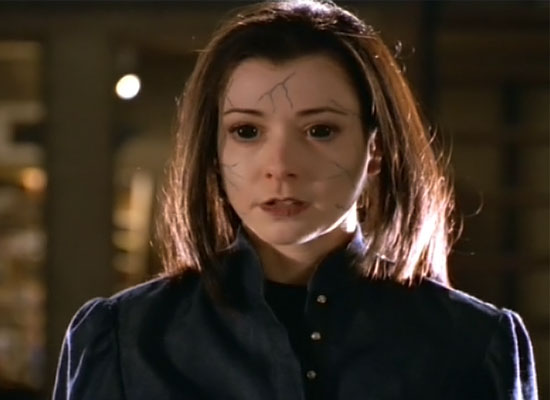
Then, the tragedy. Tara dies, from a gunshot that was meant for Buffy. Whatever kind of control Willow had got back, that and much more is instantly lost. She becomes an evil Super Witch and tries to end the world. She did for a moment turn to magic when things ended with her and Oz as well, but never anything like this. After all, she was a straight little girl back then, and her Magic Lesbian Superpowers weren't fully developed. But now we see what a long-term lesbian relationship has done to Willow, once the tiny geeky cutiepie. A lot happens, but the highlights include her fighting, both physically and psychologically, all of her best friends; she kills a man (Tara's killer) in a pretty gruesome way; and she does try to end the entire world, before good old Xander, her first crush and life-long best friend, comes along and sweet talks her out of it. Basically. But narrated in a more dramatic way than that, as I'm sure you can imagine.

You don't wanna mess with this heartbroken lesbian.


When Kennedy, the other girl that I mentioned above, who takes an interest in Willow, first gets her to play along with her flirting, Bad Willow seems to reappear. She suddenly inhabits the body of Warren, Tara's killer, and gradually turns into him mentally as well. (S)he goes right out and buys a gun and plans to kill the evil lesbian that made her do the smoochies with her. Which was the exact moment that Willow physically turned into a man, by the way – when they first kissed. But no one is killed this time around (although Willow blames herself for "killing" Tara by letting her go), as Kennedy manages to remind Willow that she is her, a woman, not a crazy blood-thirsty man. Several make-out sessions ensue, in front of people and everything, so at least that's a good thing.

It's not as if Whedon's lesbians are made out to be horrible people, and I don't think that Whedon especially dislikes lesbians. But maybe this can serve as an example of how easy it is to misrepresent something with pretty comically bad consequences. In this case though, no one, no matter what sexual orientation or gender, gets off pretty easy. Too many demons in Sunnydale for that.